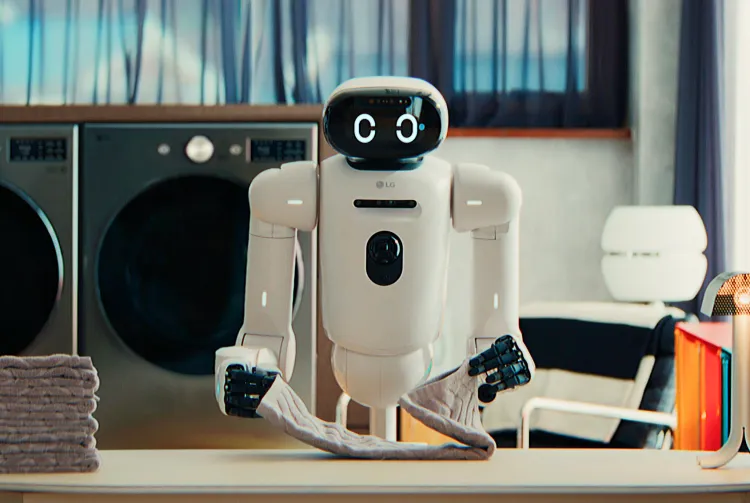
LG CLOiD at CES 2026: The Robot Butler That Actually Folds Laundry?
At CES 2026, LG unveiled CLOiD, a "Physical AI" robot butler designed to make the "Zero Labor Home" a reality. From folding laundry to making breakfast, discover why this wheeled robot might beat complex humanoids to your living room.
For decades, the ultimate promise of the "Smart Home" hasn't been a voice assistant that can tell you the weather—it’s been Rosie from The Jetsons. We’ve wanted a machine that can physically do the chores we hate, not just set a timer for them.
At CES 2026, LG Electronics is finally trying to bridge that gap.
Breaking away from the sea of stationary smart displays and robotic vacuums, LG has unveiled CLOiD, a mobile, two-armed robot designed to fulfill the company's ambitious "Zero Labor Home" vision. Unlike the concept bots of years past that merely waved at crowds, CLOiD is promising to tackle the two most hated household tasks: cooking breakfast and folding laundry.
Is this the year the robot butler becomes reality? Here is everything you need to know about LG's new flagship bot.
What Exactly is CLOiD?
The "D" in CLOiD stands for "Dynamic," and the design reflects a shift from passive observation to active participation in the home.
While competitors like Tesla’s Optimus or Figure are obsessed with bipedal walking, LG has taken a more pragmatic approach. CLOiD features a humanoid upper body with two fully articulated arms, but it sits atop a wheeled base derived from LG’s years of experience with autonomous service robots.
The Specs at a Glance:
- Mobility: Autonomous wheeled navigation (stable, safe, and efficient).
- Dexterity: Two arms with 7 degrees of freedom each (mimicking human range of motion).
- Hands: Five individually actuated fingers for fine manipulation.
- Vision: A head unit equipped with cameras and sensors that acts as the robot's "face" and AI hub.
The Killer Features: Laundry and Breakfast
LG isn't just showing off a robot that can dance; they are demonstrating specific, high-value use cases that integrate with their existing appliance ecosystem.
1. The Breakfast Routine
In LG's CES demonstration, CLOiD proves it can handle the morning rush. The robot is capable of navigating to a refrigerator, opening the door to retrieve milk, and even placing a croissant into an oven. This requires a complex combination of navigation (getting to the kitchen without hitting the dog) and manipulation (holding a fragile glass bottle without dropping it).
2. The Holy Grail: Folding Laundry
Perhaps the most impressive claim is CLOiD’s ability to manage laundry. According to LG, once the occupants leave the house, the robot can initiate a laundry cycle. But it doesn't stop there—it can retrieve dried clothes and actually fold and stack them.
Robotics experts have long cited folding laundry as a "grand challenge" because deformable objects (like a crumpled t-shirt) are incredibly difficult for computer vision to understand and manipulate. If CLOiD can do this reliably, it is a massive leap forward in consumer robotics.
The Brain: "Physical AI" and ThinQ
CLOiD isn't just operating on pre-programmed tracks. It utilizes what LG calls "Physical AI," a combination of two advanced models:
- Vision Language Model (VLM): Allows the robot to "see" and understand the context of the room (e.g., recognizing that a pile of cloth on the sofa is laundry, not trash).
- Vision Language Action (VLA): Translates that visual understanding into physical movement.
Crucially, CLOiD acts as the commander of the LG ThinQ ecosystem. It doesn't just push buttons on a washer; it communicates digitally with the appliance to know exactly when the cycle is done.
Expert Perspective: The "Wheeled" Advantage
While the tech world is currently obsessed with bipedal (walking) humanoids, LG’s decision to use a wheeled base is actually the smarter move for a consumer product in 2026.
The Bottom Line: Bipedal walking is expensive, energy-intensive, and prone to falling over. By using wheels, LG solves three problems instantly:
- Battery Life: Wheels are far more efficient than legs, allowing CLOiD to work longer shifts without charging.
- Safety: A wheeled robot has a lower center of gravity and is less likely to topple over onto a child or pet.
- Cost: It removes the need for dozens of expensive actuators in the legs, potentially making the robot affordable for wealthy consumers much sooner than its walking counterparts.
LG is betting that you don't care if your butler can climb stairs, as long as it can fold your shirts.
Conclusion: A Prototype or a Product?
LG has not yet announced a price or a release date for CLOiD. CES is notorious for "vaporware"—cool concepts that never hit the shelves. However, LG's explicit focus on "Zero Labor Home" and the integration with their real, sellable appliances suggests this is more than just a toy.
As we watch the demos in Las Vegas this week, the question remains: Will 2026 be the year we finally fire our laundry baskets?
Stay informed
Get our latest articles delivered to your inbox.
Related Articles
britannica review
Is britannica worth visiting today? From addictive daily word games to verified historical deep-dives, read our full review of the modern encyclopedia.
The Honeymoon is Over: Threads Just Turned on the Money Printer
Did you really think Mark Zuckerberg was running a charity? Of course not.
Samsung’s Android XR Glasses 2026: 12MP Camera, Dual Models, and the Fight for Your Face
Samsung is finally entering the smart glasses arena in 2026. New leaks reveal the upcoming Android XR glasses will feature a 12MP camera, deep Gemini AI integration, and a dual-model strategy to rival Meta’s Ray-Bans. Here is everything we know about the specs, the "Pro" variant, and why this could be the ultimate Android accessory.
[modo.us] Review: Is It Actually Useful or Just Hype?
Is Modo.us the best new social casino or just another coin trap? We spent two weeks testing the "Live Dealer" tables and grinding daily bonuses to see if the payouts are real—and if the $100 cash-out limit is a dealbreaker for casual players.