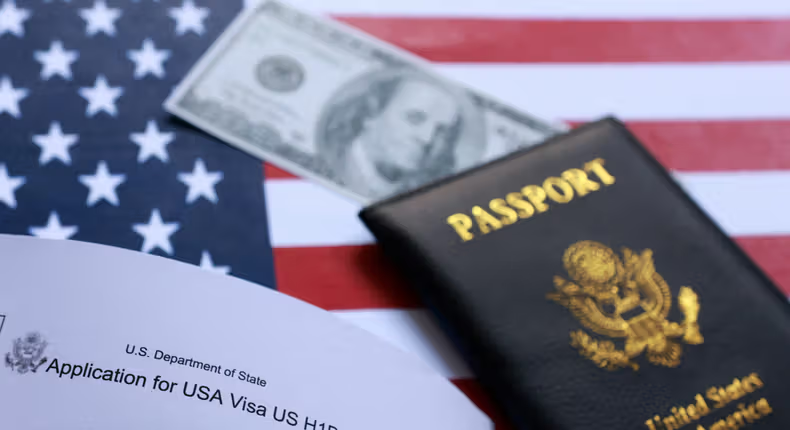
Judge Rules $100,000 H-1B Visa Fee is Lawful: The End of Affordable Tech Talent?
A federal judge has ruled that the Trump administration's $100,000 H-1B visa fee is lawful, rejecting a bid by business groups to overturn it. This analysis covers the financial shock to U.S. employers, the legal reasoning behind the decision, and the potential "brain drain" consequences for the American tech sector.
For decades, the H-1B visa program has been the lifeline for American tech giants, universities, and startups desperate for specialized skills not readily available in the domestic labor market. But in a stunning decision that has sent shockwaves through Silicon Valley and Wall Street, a federal judge has upheld the Trump administration's controversial move to skyrocket the application fee to six figures.
If you are a business leader, HR executive, or startup founder, the landscape of hiring has fundamentally changed overnight. Here is what the ruling means, why it happened, and what comes next for the U.S. labor market.
The Ruling: A Victory for "America First"
On Tuesday, U.S. District Judge Beryl Howell of the District of Columbia handed down a decisive ruling that clears the path for the administration to impose a $100,000 fee on new H-1B visa applications.
The decision rejects a legal challenge mounted by powerful industry lobbyists, including the U.S. Chamber of Commerce and the Association of American Universities. These groups argued that the fee was punitive, arbitrary, and designed to dismantle the H-1B program by making it economically unviable.
However, Judge Howell found the administration’s strategy to be lawful. The court accepted the government's premise that the fee increase acts as a necessary mechanism to:
- Curb immigration: By raising the barrier to entry.
- Prioritize U.S. workers: By making foreign labor significantly more expensive than domestic hiring.
This isn't just a regulatory tweak; it is a policy iron wall.
The Data: Breaking Down the Financial Impact
To understand the gravity of this ruling, we have to look at the numbers. The leap to $100,000 is not merely an inflationary adjustment; it is a paradigm shift.
- The New Fee: $100,000 per new application.
- The Goal: To financially incentivize companies to hire American workers by artificially inflating the cost of foreign talent.
- The Plaintiffs: The U.S. Chamber of Commerce and the Association of American Universities (both of whom failed to stop the implementation).
Why This Price Point Matters
Historically, H-1B fees have ranged in the thousands, not hundreds of thousands. A fee of $4,000 to $8,000 was a cost of doing business—an annoyance, but manageable for a Google or a Microsoft.
At $100,000, the calculus breaks.
- For a Startup: Raising a seed round of $2 million means you can hire exactly one foreign engineer if you allocate 5% of your total capital just to the visa fee.
- For Universities: Academic institutions, which rely heavily on global researchers, generally lack the profit margins to absorb such a cost.
- For Big Tech: While they have the cash, the scale of their hiring makes this prohibitive. Hiring 1,000 engineers now comes with a $100 million surcharge.
The "Unique Angle": A Soft Ban Disguised as a Fee?
While the headlines focus on the dollar amount, the strategic implication is more nuanced. This ruling validates a strategy often referred to in policy circles as "deterrence by cost."
The Expert Perspective: The administration didn't ban the H-1B visa. Banning it would require complex legislative hurdles and likely face harder constitutional challenges regarding the power of Congress vs. the Executive branch.
Instead, they effectively "soft-banned" it.
- No Legislative Battle Needed: By using administrative fee structures (likely justified under the premise of funding border security or training programs), the executive branch bypassed a gridlocked Congress.
- The "Luxury" Visa: The H-1B has been transformed from a "standard" employment tool into a "luxury" good. Only the most desperate or wealthy companies will pay this.
- The Brain Drain Risk: We must consider the secondary effect. If U.S. companies cannot afford to bring top talent here, they will likely move the jobs to the talent. Expect an acceleration of "near-shoring" (hiring in Canada or Mexico) or setting up R&D hubs in Europe and Asia where the cost of entry is lower.
The Bottom Line: This policy doesn't just protect American jobs; it potentially exports American innovation.
What This Means for Your Business
If your hiring roadmap for 2026 included sourcing talent from India, China, or Europe, you need to pivot immediately.
1. Re-evaluate Your Budget
HR departments must scrub their 2026 budgets. If you have 10 outstanding H-1B petitions, you are now looking at a $1 million liability.
2. Look for Alternatives
The H-1B is now the "premium" route. Companies will likely flood other visa categories (like the O-1 for extraordinary ability or L-1 for internal transfers), though we can expect scrutiny on those to tighten as well.
3. Remote Work is King
The greatest loophole to this fee is the internet. If a developer in Bangalore costs $100,000 extra to bring to San Francisco, the logical business decision is to leave them in Bangalore and invest in better remote collaboration tools.
Conclusion: The Fight Isn't Over, But the Damage is Done
While the U.S. Chamber of Commerce and the Association of American Universities have the option to appeal, the immediate reality is grim for proponents of open labor markets.
Judge Howell’s ruling hands the Trump administration a massive win in its long-standing campaign to reshape American immigration. The message is clear: You can hire from abroad, but you are going to pay a premium that most businesses simply cannot afford.
The big question for 2026: Will this force companies to invest in training American workers as intended, or will it simply push the world's best tech jobs outside of U.S. borders?
Stay informed
Get our latest articles delivered to your inbox.
Related Articles
britannica review
Is britannica worth visiting today? From addictive daily word games to verified historical deep-dives, read our full review of the modern encyclopedia.
The Honeymoon is Over: Threads Just Turned on the Money Printer
Did you really think Mark Zuckerberg was running a charity? Of course not.
Samsung’s Android XR Glasses 2026: 12MP Camera, Dual Models, and the Fight for Your Face
Samsung is finally entering the smart glasses arena in 2026. New leaks reveal the upcoming Android XR glasses will feature a 12MP camera, deep Gemini AI integration, and a dual-model strategy to rival Meta’s Ray-Bans. Here is everything we know about the specs, the "Pro" variant, and why this could be the ultimate Android accessory.
[modo.us] Review: Is It Actually Useful or Just Hype?
Is Modo.us the best new social casino or just another coin trap? We spent two weeks testing the "Live Dealer" tables and grinding daily bonuses to see if the payouts are real—and if the $100 cash-out limit is a dealbreaker for casual players.